
05.12.2026 Shelley Gibbins
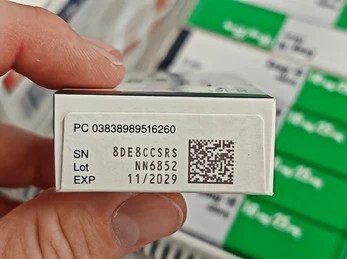
As the Royal Pharmaceutical Society calls for mandatory 2D barcodes to be included on all medication packs, Head of Marketing, Shelley Gibbins highlights why accurate barcodes are so much more than a “nice to have” in the evolving world of pharmacy.
Just last week the Royal Pharmaceutical Society released a position statement calling for 2D barcodes to be included on all medication destined for the UK supply chain. This is something that we at Centred Solutions have been advocating for so It’s great to see such a key body raising this to the top of the agenda.
Since the UK left the EU in 2020, the European Union's Falsified Medicines Directive (FMD) – which required manufacturers to include unique identifiers like GTINs within 2D barcodes on medicines packaging – no longer applies in Great Britain. And since the implementation of the Windsor Framework in January 2025, the inclusion of a two-dimensional (2D) barcode on medicine packaging has become optional. As a result, crucial data like product identifiers, batch numbers and expiry dates are lost.
Pharmacy staff are increasingly raising concerns that 2D barcodes are no longer being printed on all medicines destined for the UK supply chain according to the Royal Pharmaceutical Society (RPS). Equally worrying is the fact that there is no process that verifies whether the information on the barcode is accurate. This includes ensuring that Global Trade Item Numbers (GTINs) are not reused and that the product is represented accurately by the barcode.
Raising the Alarm
This is something that we have become acutely aware of. Last year the Centred Solutions team raised concerns to the MHRA that a duplicate barcode was circulating on some packs of Fexofenadine 120mg Tablets after it was picked up by our FLOWRx software at a customer site. As a result, several batches of Fexofenadine Hydrochloride 120mg film-coated tablets were recalled.
In a new automated pharmacy world, the inclusion of an accurate barcode on medication is absolutely crucial. More and more pharmacies are turning to technology and software that relies on barcode scanning to create efficiencies within the dispensing process so they have more time for patient-facing services in branch. When the barcode on medication is incorrect, pharmacists must stop and check the medication and will often need to print temporary labels. They also need to find time to report the incorrect barcode. This negates the efficiency and safety benefits that pharmacy dispensing technology can bring and hinders recalls and audits. When there is no barcode on medication at all, further workarounds have to be put in place creating even longer delays and creating greater risks.
‘The lack of 2D barcodes is causing disruption to robotic dispensing and supply, stock management and closed loop medicine administration processes affecting patient safety, interoperability and operational efficiencies.’ – says the Royal Pharmaceutical Society.
“Barcodes should be the most reliable part of the pack not the weakest link. Pharmacists maintain accuracy daily, yet barcode quality isn’t held to the same standards.” – PillSorted who have been campaigning on this issue.
Contingency Plans
The Royal Pharmaceutical Society has called for providers to implement contingency plans for managing medicines packs without barcodes. These could include manual verification or expiry checks. At Centred Solutions we have already evolved our software to put in place a safety net to mitigate the issue where possible. For example, our FLOWRx system checks for duplicate barcodes and will flag this at the hub so the item can be checked and resolved by a pharmacist or technician. But safety and efficiency within the medication assembly process should never come down to one individual or organisation, it needs a system-wide approach and everyone to work together. Manufacturer standards must improve so all barcodes are included and accurate to save time, improve safety and support the technology now used by pharmacy teams across the UK.
Every time a pharmacist or dispenser cannot rely on an automated barcode scan and has to switch to manual checking, it increases the risk of human error. Correct barcodes ensure pharmacy teams have an effective and robust safety net.
‘Barcode errors, duplication or absence can lead to the wrong medicine or wrong dose reaching patients, with potentially fatal consequences.’ – The Royal Pharmaceutical Society.
Impact on Medication recalls
Faulty barcodes can also impact medication recalls and audits. With technology and the right barcode, recalls and audits have never been simpler. But when a barcode is missing or inaccurate it undermines the entire process. From a regulatory and quality perspective, we cannot overestimate how important end-to-end traceability is. Whether it’s a recall, a safety alert, a regulatory audit, the ability to reliably identify packs, batches and movement is vital.
It's crucial that we recognise that a medication barcode is no longer just a packaging label, it's part of the “final check” in the patient safety chain.Waiting until a wrong medicine reaches a patient is unacceptable because building barcode reliability is possible. But it will take collaboration and shared responsibility.
What you can do today
1. Audit your barcode scans - how often do your teams override or manually verify because of scan failures?
2. Log and escalate errors - every failed scan is data. Capture it, classify it (missing code, wrong code, duplicate, unreadable) and share it with your suppliers/manufacturers.
3. Engage manufacturers - ask whether they treat barcode accuracy as part of their labelling QA process and whether they have internal metrics for barcode-failures in the field.
4. Lobby for change - if you’re a pharmacy manager or superintendent, bring this barcode-accuracy topic into your quality meetings, branch meetings, LPCs.
Find Out How FLOWRx Can Help Your Pharmacy
Barcode inaccuracies are an increasing challenge for pharmacy teams across the UK, creating delays, safety risks and additional manual workload. FLOWRx is already helping pharmacies stay one step ahead — automatically flagging duplicate and missing barcodes before they become a problem, keeping your dispensing process running safely and efficiently.
If you want to see how FLOWRx could work for your pharmacy, schedule a demo with our team today and discover how smarter dispensing technology can protect your patients and your processes.
Share