
05.12.2026 Shelley Gibbins
At Centred Solutions, our focus is supporting safe, efficient, and reliable medication and assembly workflows. That’s why the “Make Medicines Barcodes Accurate” campaign by PillSorted to make accurate GTIN (Global Trade Item Number) barcodes mandatory on all MHRA-licensed medicines resonates strongly with us. Aisling McBride, pharmacist and customer solutions specialist for Centred Solutions, explains more.
The “barcode” on medication may have seemed insignificant under the traditional pharmacy dispensing process. But community pharmacy is evolving at great speed and the sector is rapidly turning to technology as a tool to support a more efficient dispensing process. In this new world, barcode accuracy is crucial because when it fails, the consequences impact patients, pharmacy staff and the wider supply-chain.
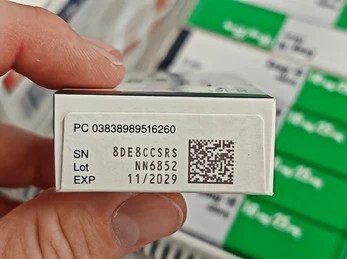
When the barcode on medication is incorrect, pharmacists must stop and check the medication and will often need to print temporary labels. They also need to find time to report the incorrect barcode. This negates the efficiency and safety benefits that pharmacy dispensing technology can bring and hinders recalls and audits. As the team at PillSorted point out, barcodes should be the most reliable part of the pack not the weakest link. Pharmacists maintain accuracy daily — yet barcode quality isn’t held to the same standards.
Standards must be improved
Incorrect barcodes on medication is a more frequent issue than you think. Our FLOWRx hub and spoke solution relies on barcode accuracy as part of the checking process and we have been working towards tackling the issue of inaccurate barcodes for a number of years now. We report incorrect barcodes every time a customer makes us aware and we have also evolved our software to put in place a safety net to mitigate the issue where possible. For example, our FLOWRx system checks for duplicate barcodes and will flag this at the hub so the item can be checked and resolved by a pharmacist or technician. But safety and efficiency within the medication assembly process should never come down to one individual or organisation, it needs a system-wide approach and everyone to work together. Manufacturer standards must improve so all barcodes are accurate to save time, improve safety and support the technology now used by pharmacy teams across the UK.
From our perspective, every time a pharmacist or dispenser cannot rely on an automated barcode scan and has to switch to manual checking, it increases the risk of human error. Mistakes are more likely to happen when systems are inconsistent or a burden. Correct barcodes ensure pharmacy teams have an effective and robust safety net.
The Impact on Pharmacy Efficiency and Safety
Every time a barcode scan fails, the assembly workflow stops. The pharmacist must break off from whatever activity they are doing to check the barcode manually and override the system that has been put in place to save time and create pharmacy capacity. From a system point of view, this lost time slows throughput, adds cost, increases staff stress and limits capacity to focus on tasks like patient consultations. At Centred Solutions we work with pharmacies to streamline their dispensing and assembly processes - reliable barcodes equal fewer exceptions and smoother operations, which in turn releases capacity for patient facing services.
Faulty barcodes can also impact medication recalls and audits. With technology and the right barcode, recalls and audits have never been simpler. But when a barcode is inaccurate it undermines the entire process. From a regulatory and quality perspective, we cannot overestimate how important end-to-end traceability is. Whether it’s a recall, a safety alert, a regulatory audit, the ability to reliably identify packs, batches and movement is vital.
What needs to happen
The campaign by PillSorted calls for the Government to make accurate GTIN barcodes mandatory in all MHRA-licensed medicines and to treat incorrect barcodes as labelling errors requiring correction or recall. This is something the team at Centred Solutions wholeheartedly support. It's crucial that we recognise that a medication barcode is no longer just a packaging label, it's part of the “final check” in the patient safety chain.
Waiting until a wrong medicine reaches a patient is unacceptable because building barcode reliability is possible. But it will take collaboration and shared responsibility. Real improvement only comes when all stakeholders engage.
What you can do today
If you work in pharmacy or any part of the medicines supply or dispensing chain, here’s what you can do right now:
- Audit your barcode scans - how often do your teams override or manually verify because of scan failures?
- Log and escalate errors - every failed scan is data. Capture it, classify it (missing code, wrong code, duplicate, unreadable) and share it with your suppliers/manufacturers.
- Engage manufacturers - ask whether they treat barcode accuracy as part of their labelling QA process, and whether they have internal metrics for barcode-failures in the field.
- Lobby for change - if you’re a pharmacy manager or superintendent, bring this barcode-accuracy topic into your quality meetings, branch meetings, LPCs.
- Support the PillSorted Campaign – Educate yourself on the PillSorted campaign and sign the petition to parliament. Make Medicine Barcodes Accurate
The PillSorted campaign is a timely reminder that the “last mile” of medicine dispensing depends on systems we sometimes take for granted. Let’s make accurate barcodes a standard part of every pack rather than an optional luxury,
Share